
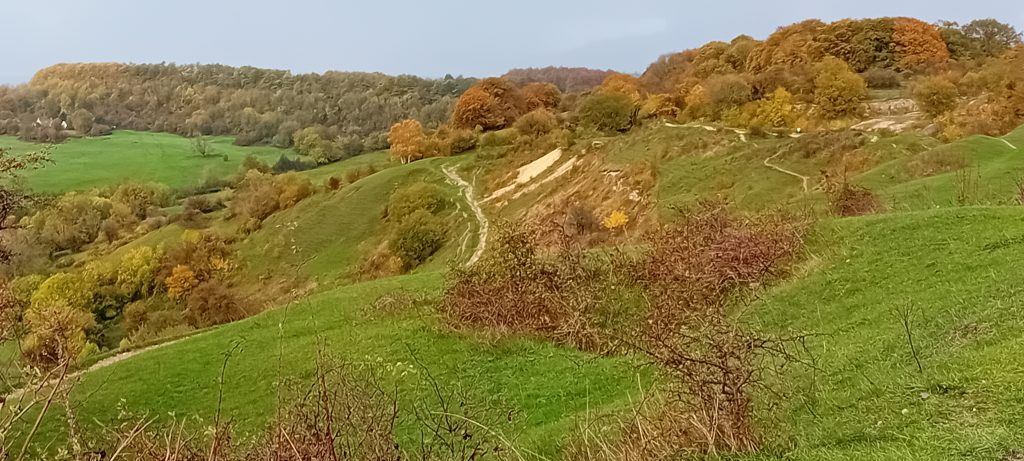
In Ice to Athelstan I mention the ancient hill fort at Crickley Hill in Gloucestershire as the site of an 4th millennium BCE massacre of the local tribe who had settled there. Having now visited the site, perched on the spur of a long ridge on the scarp slope of the Cotswolds near Birdlip, with vast views over the plain to the west as far as the Malvern Hills, I had reason to question my dating of this event. What I discovered was even more dramatic, as archaeology has identified the site as one of regular settlement and resettlement and almost as regular destruction. The earliest evidence even goes back to the Mesolithic, with tiny postholes from the time of hunter-gathers indicating that small houses were built there over 6,000 years ago.
Around 1,000 or more years later, early neolithic farmers brought their animals and plants to the site, which they protected with a bank of stone quarried locally with antler picks, later reinforced by a second, steeper bank with gated entrances operating as a causewayed enclosure. Even so, the evidence, including a proliferation of sharp flints, it seems that the site was overrun and anything on it burned to the ground several times over the centuries until it was abandoned around 3,600 BCE. But only 50 or so years later fresh reinforcements were built, preserving the assumed spiritual qualities of the old structures, with a nearby shrine adding to the mystery. But this too ended with a violent attack and burning – around 3,450 BCE (as I had recorded it) – evidenced by hundreds of flesh-penetrating flint arrowheads found there.
Although this saw the end of that occupation, the site seems to have become a religious centre with a circle of small standing stones where ceremonial animal sacrifices were made to the gods. Until that too was pulled down and desecrated. The years and centuries tick forward again, until around 600-700 BCE, when a new breed of Iron Age settlers, perhaps an elite of about a hundred strong, built long timber houses and grain storage structures protected by a reinforced high stone wall. Once again, the defences were overrun and the settlement destroyed and burned. Once again newcomers established themselves there and built even stronger defences and once again they were attacked and destroyed, seemingly by 400 BCE.
This time, although the site may have been used for some purposes, it does not appear to have been settled during Roman times. But sometime after 400 CE the familiar prehistory pattern of occupation, fortification and destruction repeated itself as society adjusted to the collapse of Roman ‘civilisation’. After that it finally returned to pasture until meticulously excavated and placed into the care of the Gloucestershire County Council and the National Trust. For all that, while many of the key dates can be identified, we are no clearer as to the people who settled on the hill or why they were so forcibly removed. We might guess that such a key position would seem like a threat to others, but that may be the best we can do.