
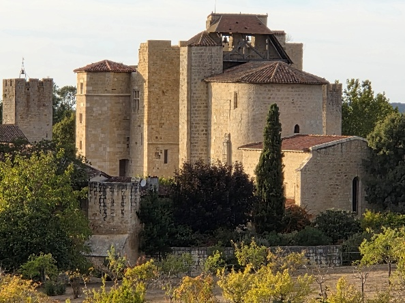
This is what remains of the bastide – fortified village – of Larressingle in south-west France, just south of the strikingly-named town of Condom in what used to be called Gascony. Behind the dry moat and curtain walls there’s a fine church, a keep (on donjon in French), some stunning towers and, for today’s pilgrims en route to Santiago, a snack and drinks bar inside and a fine shaded restaurant just outside the walls. And this was the view we had from the superb but self-effacing modern house where we had the pleasure of spending a week with friends.
But you won’t find Gascony on many current French maps, even though it was fiercely fought over by the kings of England in medieval times. In this period Gascony was the name given to the ever-decreasing remains of the formerly vast Aquitaine, acquired by England when Henry II of England married the redoubtable Eleanor of Aquitaine in 1152. The region where this bastide is located is now called Gers (with a soft’ g’), distinguished on a topographical map by the series of rivers than fan out from the Pyrenees to the south to run north and north-east towards the Garonne River which feeds Bordeaux and the Gironde Estuary. Today the rolling countryside remains inviting, graced by green ridges, church spires, old walls and buildings, and studded with vineyards. There is much to be discovered.
Aquitaine was held as a fief of the King of France, meaning that whoever ‘owned’ the land was bound to acknowledge the overlordship of the then current King of France, something England’s Plantagenet kings were often slow and reluctant to do. This and the fact that power groups, especially in northern Aquitaine, resented any kind of overlordship meant that innumerable wars were fought by the English kings over the 12th to 15th centuries to try to maintain their hold over this area. Over the centuries therefore, ‘English’ Aquitaine was progressively reduced until it became a rump around Bordeaux, maintaining English presence as a vital trading port, especially in the wine trade, and a small area in the coastal south-west near the Spanish border, until these two were absorbed by France.