
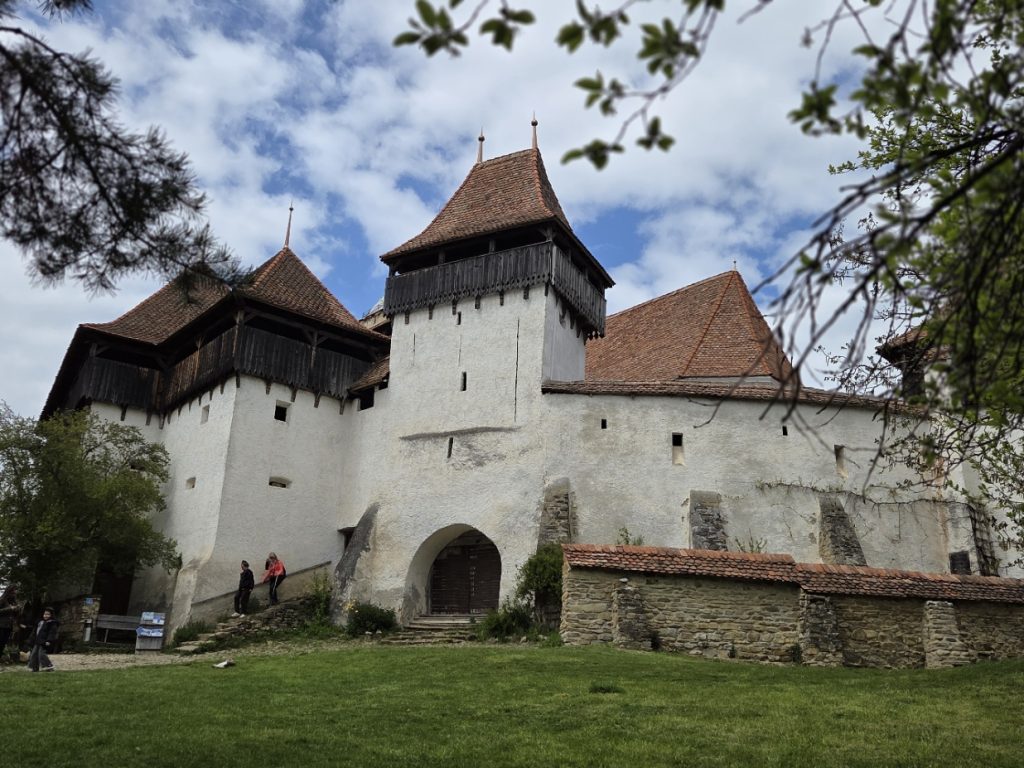
This castle-like building is actually a Saxon fortified church at Viscri, in the heart of Transylvania, which we visited about three weeks ago. We were on a Distant Horizons small group tour of Romania, with several visits to painted and/ or fortified churches there, mainly in Moldavia in the north-east and Transylvania across the eastern Carpathians. We may be familiar with the arrival of the Angles and Saxons in Britain from the 5th century CE onwards, but why was this church ‘Saxon’ when it’s nowhere near Saxony; and why was it fortified?
On the first question we might reflect that, even in so-called Anglo-Saxon times in Britain, the term ‘Saxon’ was used fairly indiscriminately. Supposedly named after the seaxe, a long knife or short sword, the name was often attributed by the Romans and Britons to what we’d now call pirates – basically maritime freebooters – as well as for Germanic auxiliaries, many of whose families may have stayed in Britain as the Romans progressively streamed out. It was then used for many of those who came from the Germanic south side of the borders of soon-to-be Denmark, which may have included Frisians living in the Low Countries. Later, the term ‘Anglo-Saxons’ distinguished the ‘Saxons’ who had settled in Britain from the Saxons who remained in German Saxony.
Something similar seems to have applied in what we now call Romania, whose history makes ours look straightforward by comparison, when Transylvania (the land beyond the forests) was under the control of Hungarian kings. In the 12th century onwards, groups from the old Holy Roman Empire were invited by the then Hungarian king to settle in Transylvania in return (among other things) for helping defend the then eastern borders of Hungary against attack. The fact that many such settlers were from such localities as (what are now) Luxembourg, the Low Countries and Bavaria did not stop them being classified as Saxons, perhaps because some might have crossed through Saxony en route to Transylvania. And the fortifications? As the Saxons settled and built increasingly precious (mainly Orthodox Christian) churches and monasteries, they became targets for raiding warbands – and later from factions of the Ottoman armies. To counter this the Saxons built fortifications around their churches and monasteries, sometimes to a quite elaborate extent – with outer walls, approach tunnels, battlements and huge attics with readily accessible narrow windows for firing at enemies.
If you could reverse time by three or more centuries it’s a trick the Anglo-Saxons might have used against the early Vikings, had they known how. As it was, King Alfred and his successors later used the system of fortified townships – known as burghs – very effectively to help turn the tide against the Vikings. And the Romanian Saxons? After WW2 many chose to ‘return’ to a Germany they had never lived in but whose language they still spoke, with a widespread diaspora elsewhere. Fortunately today, many of their fortified and painted churches live on, protected in newer, and less violent, ways.